Quick answer: A readability score is a formula-based estimate of how easy a piece of text is to read, based on measurable factors like sentence length, word length, and syllable count. Tools like Flesch Reading Ease turn those factors into a single number. Readability is not a confirmed direct Google ranking factor — Google has never listed it as a signal — but it correlates with things that do matter: how long people stay on a page, whether they bounce back to search results, and whether they finish reading and take action. The score itself won’t move your rankings. The behavior it reflects might.
What a readability score actually measures
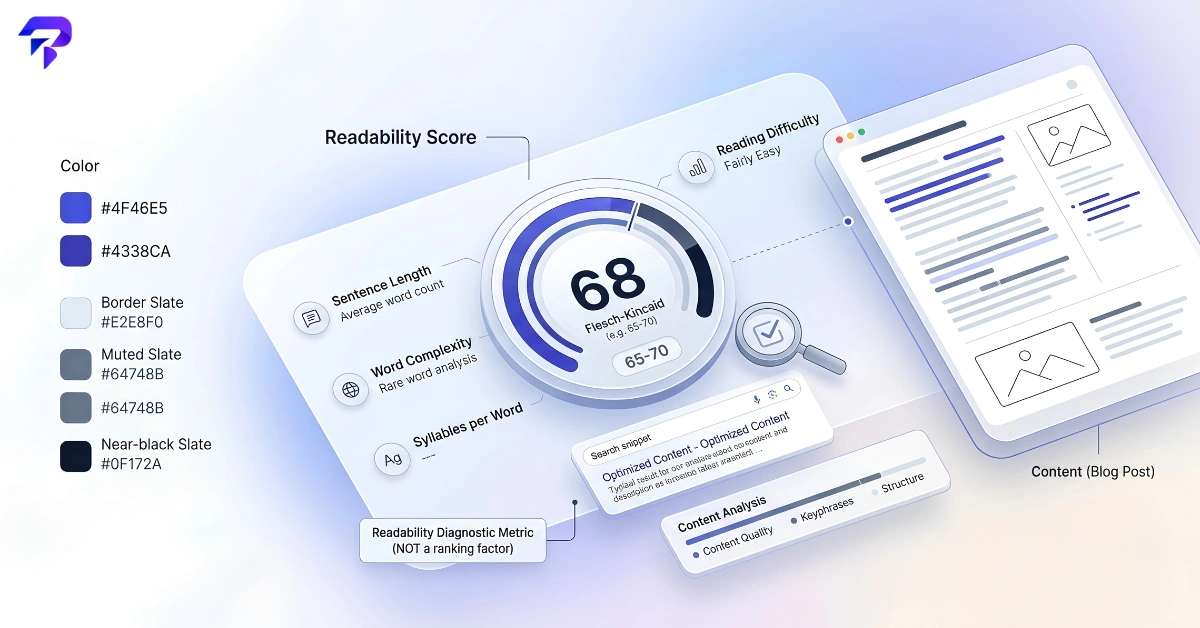
Most readability formulas were built decades before SEO existed. Flesch Reading Ease, the one you’ll see most often in content and SEO tools, dates back to the 1940s. It runs a simple calculation using average sentence length and average syllables per word, then outputs a number from 0 to 100. Higher means easier to read. Lower means denser, more demanding text.
That’s it. The formula has no idea what your sentence is about, whether it’s factually correct, or whether it’s well-argued. It only counts. A short, choppy sentence full of one-syllable words scores well even if it says nothing useful. A precise, well-constructed sentence in a legal brief or a clinical study scores poorly even though it’s doing exactly what it should. Readability scores measure structural difficulty, not quality.
Other formulas — Flesch-Kincaid Grade Level, Gunning Fog, SMOG — use similar inputs to estimate the U.S. school grade level a reader would need to follow the text comfortably. They’re variations on the same idea: count the words, count the syllables, count the sentence breaks, and estimate friction.
Why readability scores are suddenly everywhere
This isn’t a new metric — it’s an old metric getting new attention, for a few concrete reasons.
First, there’s simply more content competing for the same attention. When search results are crowded with pages covering the same topic, the pages that keep people reading tend to hold their position better than pages people abandon quickly. Content teams have gotten more disciplined about anything measurable that might explain why one page performs and another doesn’t, and readability is easy to measure.
Second, the volume of AI-assisted writing has changed what “average” content looks like. A lot of AI-generated drafts default to a particular rhythm — longer sentences, hedging phrases, uniform paragraph lengths — that reads as generic even when it’s technically correct. Readability scores became one of several quick signals editors use to catch text that needs a human pass, alongside things like sentence variety and repetition.
Third, readability scoring got a lot more accessible. It used to require a manual formula or a Word plugin. Now it’s a default panel in most content editors and a one-click check in browser-based tools, so more people are seeing the number whether they went looking for it or not.
What the score ranges actually mean in plain terms
Flesch Reading Ease scores fall into rough bands. These are general guidelines, not hard rules:
- 90–100: Very easy. Simple, short sentences — think children’s books or basic instructions.
- 70–89: Easy to fairly easy. Conversational blog posts, product pages, most consumer-facing web copy land here.
- 60–69: Plain English, standard for general web content. Often cited as a reasonable target for a broad online audience.
- 50–59: Fairly difficult. Common in trade publications, opinion pieces, and content aimed at an informed but non-expert reader.
- 30–49: Difficult. Typical of academic writing, detailed technical documentation, or dense professional content.
- 0–29: Very difficult. Legal contracts, scientific papers, and highly technical specifications regularly score here — and that’s expected, not a failure.
The important thing about this scale is that it describes structural complexity, not appropriateness. A 35 isn’t automatically bad writing. It’s writing that requires more from the reader, which is sometimes exactly the point.
Is readability a Google ranking factor?
No — and it’s worth being direct about this because it gets overstated constantly. Google has not confirmed readability score as a direct ranking signal. There’s no algorithm update, documentation, or public statement tying a Flesch score to search position. Anyone telling you “aim for a 65 or Google will penalize you” is stating an opinion as if it were policy.
What readability does have a documented relationship with is user experience — and user experience feeds into things Google does care about, even if indirectly. If your content is dense enough that visitors leave within a few seconds, that’s a real problem regardless of what any algorithm rewards. Search engines aim to serve pages that satisfy the person searching, and a page nobody finishes reading is a weak candidate for “satisfying,” independent of any specific scoring mechanism. The same logic applies to more technical page-experience signals like Core Web Vitals — neither is a dominant ranking factor on its own, but both correlate with whether someone actually gets value out of the page. If you’re tracking whether any of this actually moves your rankings, keep in mind that a single manual search doesn’t show a reliable number either — see why Google rankings fluctuate and how rank trackers measure position for why.
So the honest framing is: readability is not a ranking input, but it’s a decent proxy for whether real people can actually use your content once they land on it.
Why easier-to-read content still helps you
Set the SEO angle aside for a second and think about what happens on the page itself. Dense, run-on writing forces readers to work harder to extract the point. Some will push through. Many won’t — they’ll skim, get lost, and leave. That shows up as shorter time on page and higher bounce rates, both of which reflect real reader behavior rather than a formula’s opinion.
Clearer writing also tends to communicate the actual value proposition faster — which matters directly for conversion, not just for some abstract “engagement” metric. If someone lands on a product page or a how-to guide and the first two sentences are a wall of qualifiers and nested clauses, they don’t know yet whether you’ve answered their question. Trim that friction and they find out sooner.
None of this requires dumbing content down. It requires cutting words that aren’t earning their place: unnecessary hedges, redundant phrases, sentences that string three ideas together when one idea per sentence would land cleaner. That’s a self-editing improvement people notice, whether or not they ever see the underlying score.
How much should you actually optimize for it

Treat a readability score as a diagnostic, not a target to hit. Run a draft through a readability score checker after you write it, not while you’re writing it — chasing a number in real time tends to produce choppy, over-simplified sentences that read worse, not better.
Then judge the result against your actual audience, not a universal ideal:
- General consumer content, how-to guides, and most small-business blogging: aim for something comfortably in the “plain English” range. Your reader is likely scanning on a phone, not settling in for a close read.
- B2B, industry, or trade content: a somewhat harder score is normal, because your reader already has domain vocabulary and shorthand.
- Technical, medical, or legal content: expect — and accept — a lower score. Precision and correctness outrank simplicity here. Rewriting a dosage guideline or a contract clause purely to chase an easier score risks losing the specificity that made it accurate in the first place.
Readability also isn’t a competition against keyword optimization — the two solve different problems and both matter in proportion. Stuffing a target keyword into every other sentence hurts readability and reads as spam; a well-written paragraph that mentions the topic naturally a handful of times reads better and still signals relevance. If you’re unsure whether a draft leans too hard on repetition, run it through a keyword density checker alongside the readability check — the goal is balance, not maximizing either number in isolation. (Worth knowing: keyword density itself isn’t a ranking factor either — Google has said as much directly — so treat both checks as sanity checks, not targets.) It also helps to keep an eye on overall length with a word counter, since padding a post to hit a word count is one of the fastest ways to tank readability without adding value.
FAQs
Is a low readability score bad for SEO?
Not directly. There’s no confirmed penalty tied to the score itself. A low score becomes a problem only if it means real readers are struggling to get through your content and leaving before they find what they came for.
What’s a good Flesch Reading Ease score for a blog post?
Most general-audience blog content lands well in the 60–70 range. That’s a reasonable target for readability, not a requirement — plenty of well-performing posts sit outside it depending on topic and audience.
Should technical or medical content aim for a higher readability score?
Not at the cost of accuracy. Expert or specialist content naturally scores lower because it uses longer, precise terminology that a simplified version can’t replace without losing meaning. A lower score in that context reflects the subject matter, not a writing problem.
Does keyword density affect readability?
Yes, indirectly. Repeating a keyword unnaturally to hit a density target usually makes sentences more awkward and less readable. It’s worth checking both, since improving one for its own sake can quietly damage the other.
Can I improve my readability score without changing my message?
Usually. Shortening sentences, replacing multi-syllable words with simpler alternatives where meaning doesn’t shift, and breaking up long paragraphs will raise the score without changing what you’re actually saying. Readability is one half of a piece of content actually working for a reader; originality is the other. If you’re publishing anything meant to rank, it’s worth checking both — see how plagiarism checkers actually work before you hit publish. It’s also worth knowing that word count, character count, and reading time each measure something different — see what each one actually measures before you set length targets for a piece.
The bottom line
A readability score is a rough, formula-based estimate of reading difficulty — useful as a quick check on your own writing, not a metric to chase for its own sake. Google has never confirmed it as a ranking factor, but the underlying idea — that content people can actually get through tends to perform better — holds up regardless of what any algorithm rewards. Write for the person who’s actually going to read the page. If that’s a general audience, simplify. If that’s a specialist reading a technical spec, let the score sit lower and don’t apologize for it.
Run your next draft through the Readability Score Checker to see where it lands, then decide — with your actual reader in mind — whether it’s worth changing anything at all.