
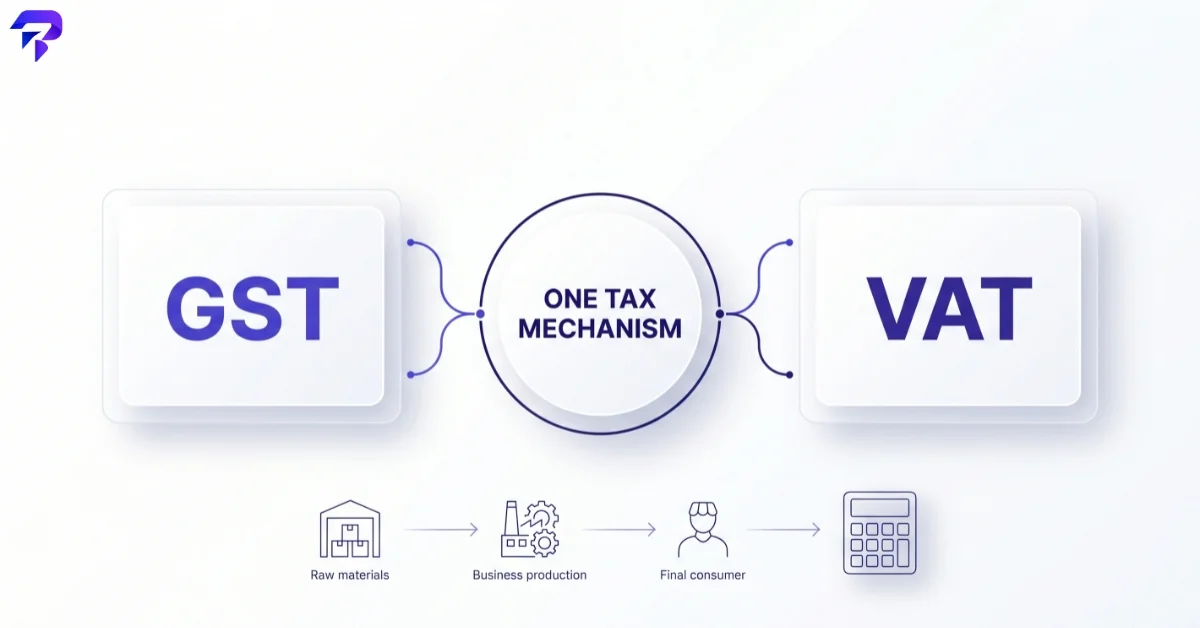
Quick answer: GST (Goods and Services Tax) and VAT (Value Added Tax) are, in almost every practical sense, the same tax wearing two different name tags. Both are consumption taxes collected in stages along the supply chain, and both let registered businesses reclaim the tax they’ve already paid on their own purchases (their “input tax”) so that, ultimately, only the end consumer bears the cost. The real difference isn’t in how the tax works — it’s in who uses which word. Countries like the UK, the EU member states, the UAE, Saudi Arabia, and most of Africa and Latin America call it VAT. Countries like India, Australia, New Zealand, Canada, and Singapore call it GST. A few places, like India, layer extra structure on top (splitting it into central and state components). But the core mechanism — tax added at each stage of production, credited back to businesses, ultimately paid by the final buyer — is functionally identical. Calculating either one uses the exact same math.
If you just need a number, skip to the GST calculator or VAT calculator and get your answer in seconds. If you want to actually understand what you’re calculating and why the two terms exist, keep reading.
What VAT Actually Is
VAT stands for Value Added Tax. It’s a consumption tax charged at every stage of a product’s journey from raw material to finished sale — but only on the value added at that stage, not on the full price each time.
Here’s the mechanic in plain terms: a business charges VAT on what it sells (output tax) and pays VAT on what it buys (input tax). It remits the difference to the tax authority. If a furniture maker buys wood for $100 plus VAT, then sells a finished chair for $300 plus VAT, it doesn’t pay tax on the full $300 again — it only owes tax on the $200 of value it added, because the VAT it already paid on the wood is credited back.
This is what makes VAT different from a simple sales tax: it’s collected in installments across the whole supply chain rather than as one lump sum at the checkout counter, and businesses in the middle of that chain don’t actually bear the cost — they pass it through.
VAT is the more common global term. It’s used across the European Union, the United Kingdom, the UAE, Saudi Arabia and most of the Gulf, China, and the majority of countries in Africa and Latin America. Estimates put the number of countries with a VAT or VAT-equivalent system at over 170 worldwide — making it the dominant consumption tax model on the planet, far more common than the retail sales tax model used in the United States.
France is generally credited as the first country to implement a modern VAT system, in 1954, designed by economist Maurice Lauré. The idea then spread through Europe and eventually most of the world over the following decades.
What GST Actually Is
GST stands for Goods and Services Tax, and mechanically, it is the same kind of tax as VAT: multi-stage, credit-based, ultimately borne by the end consumer. The name “GST” is mostly a branding choice made by a specific group of countries — most notably India, Australia, New Zealand, Canada, Singapore, and a handful of others — when they introduced their own consumption tax systems.
Where GST diverges slightly from a “textbook” VAT is in structure, not mechanism, and mainly in countries with federal systems of government. India is the clearest example: because India has both a central government and state governments that each need tax revenue, its GST is split into components — Central GST (CGST) and State GST (SGST) on transactions within a state, and Integrated GST (IGST) on transactions between states. Canada does something similar in spirit: it has a federal GST, and several provinces layer a Harmonized Sales Tax (HST) on top that combines the federal and provincial portions into a single rate, while other provinces charge a separate, non-creditable Provincial Sales Tax (PST) alongside GST.
Australia and New Zealand, by contrast, keep it simple: a single flat national GST rate with relatively few exemptions, which is often held up as one of the cleaner implementations of this tax model anywhere in the world.
So Is GST Just VAT With a Different Name?
Essentially, yes — with the caveat that “essentially” is doing real work in that sentence.
At the mechanism level, GST and VAT are the same idea: a multi-stage, destination-based consumption tax with input tax credits, ending in the same place — the final consumer pays it, businesses along the way are largely tax-neutral. Tax authorities, economists, and international bodies generally treat them as the same category of tax for comparative purposes.
Where they genuinely differ is in implementation details that vary by country regardless of which name is used:
- Number of rates. Some countries run one flat rate on almost everything (New Zealand, Australia). Others run multiple tiers for different categories of goods (reduced rates for food or books, a standard rate for most things, higher rates for luxury or “sin” goods). This variation exists on both the GST side and the VAT side — it’s not a GST-vs-VAT split, it’s a country-by-country choice.
- Federal vs. unitary collection. Federal countries (India, Canada) sometimes split the tax into national and sub-national pieces. Unitary countries (UK, Australia, New Zealand) usually don’t.
- What’s exempt or zero-rated. Every country carves out its own exceptions — exports are typically zero-rated everywhere, but beyond that, exemptions for essentials like groceries, medicine, education, or financial services vary enormously.
- The name itself can change. Malaysia used GST from 2015 to 2018, then abolished it and reverted to a Sales and Service Tax (SST) — a reminder that these labels aren’t fixed forever and that “GST” doesn’t guarantee identical rules to any other GST country.
If you’re doing business or filing in a specific country, the label (GST or VAT) tells you almost nothing useful on its own. What matters is that country’s specific rate, registration threshold, exemption list, and filing rules.
GST/VAT vs. Sales Tax: The Distinction That Actually Matters
If you’re comparing tax systems, the meaningful split isn’t GST vs. VAT — it’s GST/VAT vs. traditional retail sales tax (the model most familiar to anyone in the United States).
| VAT / GST | Retail Sales Tax (e.g., US) | |
|---|---|---|
| Collected | At every stage of the supply chain | Only at the final sale to the consumer |
| Businesses in the middle | Pay tax on purchases, reclaim it via input credits | Generally exempt with a resale certificate — no credit mechanism needed |
| Visibility to tax authorities | Tax is documented at every transaction, making it harder to evade | Only the final transaction is taxed, so revenue relies on point-of-sale compliance |
| Who administers it | Usually a single national (or, in federal systems, national + regional) tax authority | Often state and local, with rates varying block by block in some countries |
| Global prevalence | Used by 170+ countries | Used mainly in the United States among developed economies |
This is the comparison that actually changes how a business operates — a company selling into both, say, the UK and the US needs genuinely different compliance processes for each, not just a different rate.
How VAT/GST Calculations Actually Work
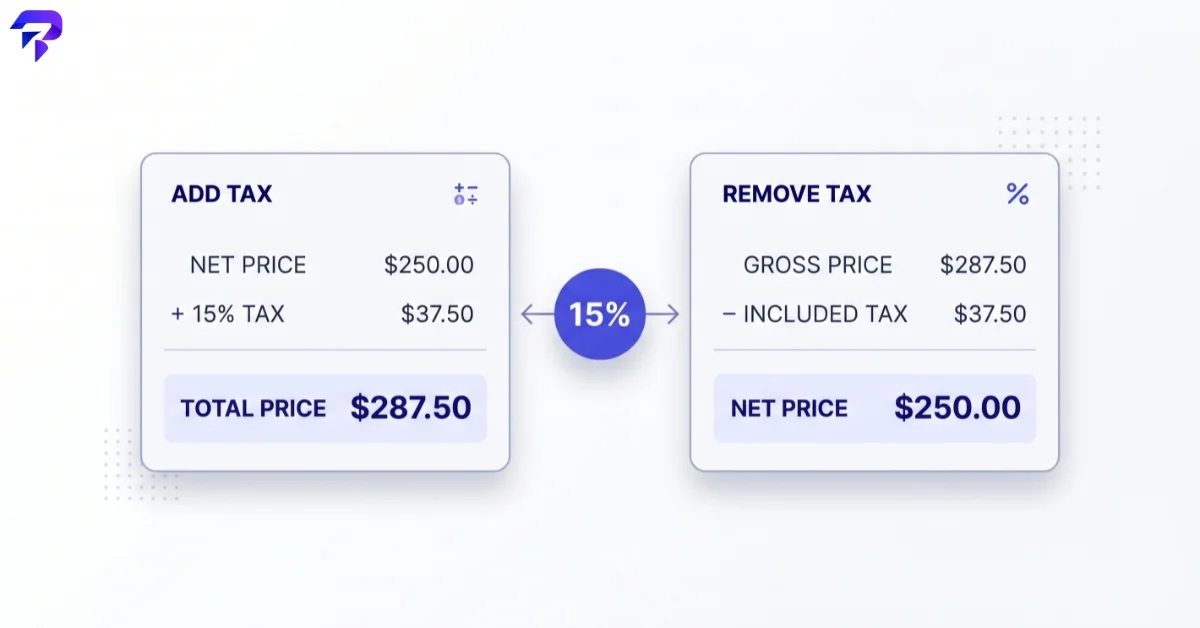
Whether you call it VAT or GST, the arithmetic is the same. There are two directions you’ll typically need to calculate:
1. Adding tax to a net (tax-exclusive) price
If you have a price before tax and need the tax-inclusive total:
Tax amount = Net price × (Rate ÷ 100)
Gross price = Net price + Tax amount
Example: a $250 service at a 15% rate. Tax amount = $250 × 0.15 = $37.50. Gross price = $250 + $37.50 = $287.50
2. Extracting tax from a gross (tax-inclusive) price
This is the one people get wrong more often — if a price already includes tax and you need to know how much of it is tax, you can’t just multiply by the rate again. You have to divide it out first:
Net price = Gross price ÷ (1 + Rate ÷ 100)
Tax amount = Gross price − Net price
Example: a $287.50 price that already includes 15% tax. Net price = $287.50 ÷ 1.15 = $250. Tax amount = $287.50 − $250 = $37.50
The mistake to avoid: taking a tax-inclusive price and multiplying it by the rate directly (e.g., $287.50 × 0.15) — that overstates the tax, because it taxes the tax itself. Always divide by (1 + rate) when working backward from a gross price.
Rather than doing this by hand every time — especially with multi-tier rates like India’s, or when you’re juggling several countries’ rates — ToolPremier’s GST calculator and VAT calculator handle both directions instantly: enter a price, pick “add” or “remove,” set the rate, and get the exact breakdown. If you need a broader look at total tax burden — combining consumption tax with income or business tax scenarios — the tax calculator is built for that wider view.
Where This Trips People Up
A few recurring mistakes, regardless of which country or label is involved:
Confusing tax-inclusive and tax-exclusive pricing. In some countries, advertised consumer prices legally must include VAT/GST (much of the EU and UK). In others, especially B2B contexts and the US, prices are usually quoted before tax. Mixing these up when quoting a client or building a budget is one of the most common (and most embarrassing) errors in freelance and small-business invoicing.
Assuming one rate applies to everything. Multi-tier systems are common. Groceries, books, children’s items, and medical supplies are frequently taxed at reduced or zero rates even in countries with a high standard rate — while luxury goods can carry a materially higher rate than the standard one. Always confirm the rate for the specific category of good or service, not just the country’s headline rate.
Treating VAT/GST as a cost that eats into margin. For a properly registered business, VAT/GST collected from customers isn’t revenue, and VAT/GST paid on inputs isn’t an expense — both net out through the credit mechanism, and the business is essentially a collection agent for the government in between. When you’re pricing a product or reviewing your numbers, it helps to look at true profit margin separately from tax pass-through — the profit margin calculator keeps that distinction clean.
Forgetting to itemize it correctly on invoices. Most jurisdictions require the tax rate, tax amount, and your tax registration number to appear clearly on invoices once you’re registered — a client-facing total with no breakdown is often not compliant. ToolPremier’s invoice generator itemizes tax automatically so it’s shown correctly instead of buried in a single lump total.
Not budgeting for tax as a business owner. If you invoice with GST/VAT added, that portion of every payment you receive already belongs to the tax authority — it was never really your income. Freelancers and small businesses that spend it as if it were their own often end up short when the filing deadline arrives. Running the numbers through a budget planner that separates collected tax from actual earnings avoids that surprise.
A Quick Regional Snapshot
Rates and rules shift often, so treat these as general orientation rather than filing-ready numbers:
- European Union & UK: Called VAT. EU directive sets a 15% minimum standard rate for member states, and in practice most sit well above that — actual standard rates across the EU currently span roughly the high teens to high twenties, with the UK’s standard rate at 20%.
- India: Called GST, structured as CGST + SGST (in-state) or IGST (interstate). India moved to a simplified rate structure in September 2025, consolidating most goods and services into two main slabs, with a higher slab reserved for luxury and “sin” categories, and some essentials at zero or minimal rates.
- Australia: Called GST, a single flat 10% rate with relatively few exemptions (fresh food and some health/education services are notable exceptions).
- New Zealand: Called GST, a single flat 15% rate applied broadly with very few exemptions — one of the simplest systems in the world to calculate.
- Canada: Called GST federally (5%), but several provinces harmonize it with a provincial component into a single HST rate, while others charge a separate PST alongside the federal GST — meaning the effective rate genuinely depends on the province.
- Singapore: Called GST, a single national rate applied to most goods and services.
- United States: Uses neither term — sales tax instead, set at the state and local level with no federal VAT/GST and no input credit system.
FAQs
Does every business have to register for VAT/GST, regardless of size?
No — most countries set a revenue threshold below which registration is optional or not required at all. A small freelancer or business under that threshold typically doesn’t charge VAT/GST and can’t reclaim input tax on purchases either, since registration is what unlocks the credit mechanism in both directions. The specific threshold varies enormously by country, so check your local tax authority’s current figure rather than assuming a global standard.
Can a regular consumer reclaim VAT/GST the way a registered business can?
No, and that’s essentially the whole design of the tax. The input tax credit mechanism exists only for registered businesses moving goods and services along the supply chain — it’s what keeps the tax from stacking at every stage. The end consumer is the one point in the chain with no one to pass the cost to, which is exactly why the tax is described as ultimately borne by the consumer. (Tourist VAT refund schemes in some countries are a narrow, specific exception for goods being taken out of the country — not a general consumer credit.)
Are digital products and services taxed the same way as physical goods?
Not always. A number of countries and regions have added specific rules for digital goods and services — software, streaming, downloadable content — that tax the sale based on the customer’s location rather than the seller’s, which is different from how physical goods are typically sourced. If you sell digital products across borders, it’s worth checking whether the destination country has a digital-specific VAT/GST regime rather than assuming the standard physical-goods rules apply.
What happens if a business collects VAT/GST from customers but doesn’t remit it?
Because the tax was collected on behalf of the government rather than earned as revenue, most jurisdictions treat unremitted VAT/GST more seriously than an ordinary unpaid business debt — it’s generally classed as a compliance and legal matter, not just late payment. Exact consequences (penalties, interest, personal liability for business owners in some structures) vary by country, so this is one area where confirming your jurisdiction’s specific rules matters more than the general principle.
A Note on Accuracy
Tax rates, thresholds, exemptions, and rules change — sometimes with little notice, and they vary meaningfully by country and even by region within a country. Nothing here should be treated as filing guidance for your specific situation. Before you charge, remit, or claim GST or VAT on an actual transaction, confirm the current rate and rules with your country’s official tax authority or a qualified tax professional. The calculators on ToolPremier are built to make the arithmetic fast and accurate once you know the correct rate — they’re not a substitute for confirming that rate is right for your jurisdiction and situation.
The Bottom Line
GST and VAT are, for nearly all practical purposes, the same tax under two different names — a multi-stage consumption tax with input credits, paid ultimately by the end consumer. The label tells you which region’s terminology you’re dealing with, not how the math works. What actually varies is country-specific: the rate, the number of tiers, what’s exempt, and how the tax is split between national and regional authorities. Once you know your country’s correct rate, the calculation itself — adding tax to a net price or extracting it from a gross one — is identical everywhere. Run it through the GST calculator or VAT calculator rather than doing it by hand, and you’ll never risk the tax-on-tax mistake that trips up manual math.