

How keyword density is calculated
The formula is simple: divide the number of times a keyword appears by the page’s total word count, then multiply by 100. Using a keyword 10 times in a 1,000-word article works out to a 1% density. A keyword density checker automates this count so you’re not doing it by hand across a long page.
Why this used to be treated as a target
In early search engine algorithms, keyword frequency was a meaningfully larger signal than it is now — search engines had far less capability to understand meaning, synonyms, or context, so counting exact keyword occurrences was one of the more reliable ways to guess what a page was about. That’s where the idea of a target density (often cited as somewhere around 1–3%) came from, and it’s why the practice stuck around in SEO advice long after it stopped being accurate.
What Google has actually said about it
Google’s own statements on this are unambiguous. Former Google engineer Matt Cutts said directly that he’d “love it if people could stop obsessing about keyword density.” Google’s Search Advocate John Mueller has echoed this: “Keyword density, in general, is something I wouldn’t focus on. Make sure your content is written in a natural way.” Neither statement leaves room for “but a specific percentage still helps” — the guidance is to write naturally and let relevance come from that, not from hitting a number.
The related trap: keyword stuffing
Chasing a density target is also how content ends up keyword-stuffed — unnaturally repeating a phrase past the point where it reads normally. Google explicitly lists keyword stuffing as a spam practice, and it can trigger both algorithmic and manual penalties. The irony is that the practice people once used to try to rank higher is now something that can actively hurt a page’s ranking.
What actually matters instead
Modern search relevance comes from a page thoroughly covering the topic a searcher is looking for — including the related terms, subtopics, and questions someone researching that topic would expect answered — not from how many times one exact phrase appears. In practice, that means: write for the person reading the page first, use your primary term and its natural variations where they fit (not forced into every paragraph), place it in genuinely important spots like the title and an early heading, and cover the subtopics a thorough answer to the query would need.
A practical example
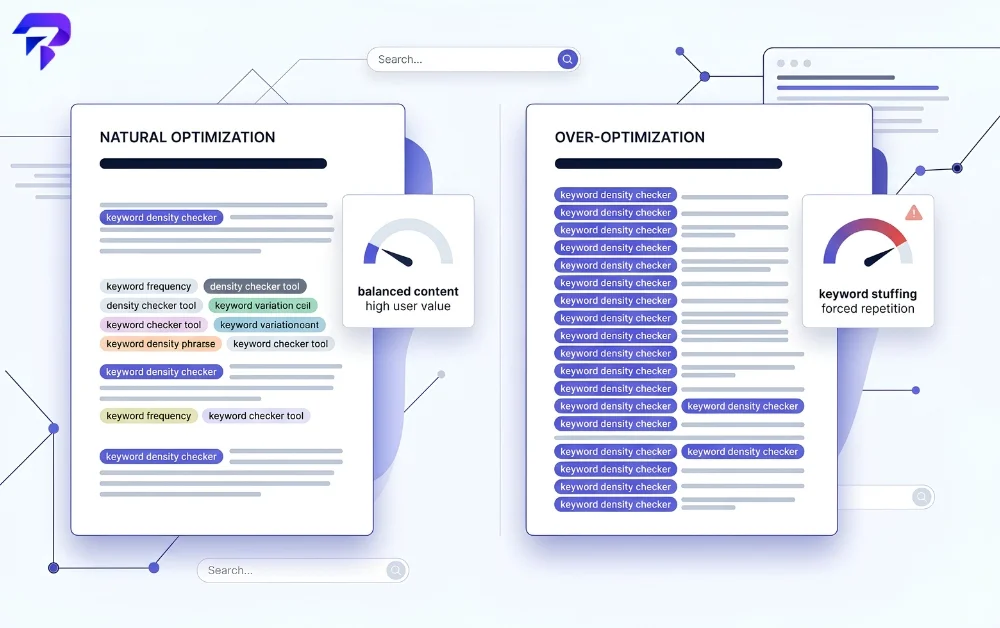
Say you’re writing a 900-word article targeting “keyword density checker.” Using that exact phrase 3 times works out to roughly 0.3% density — nowhere near the old 1–3% “target” range, and that’s completely fine, because the page can still be highly relevant if it also naturally uses “keyword frequency,” “density checker tool,” “how often a keyword appears,” and answers the actual questions someone searching that term would have. A page that hit an artificial density target by repeating the exact phrase 20 more times wouldn’t rank better for it — it would just read worse and risk looking like stuffing.
So is a keyword density checker still worth using?
Yes, but for a different reason than “hit this percentage.” It’s useful as a sanity check in both directions: catching a page that’s accidentally repeating a phrase so often it reads awkwardly (a sign to rewrite, not a ranking problem to fix with a number), and catching a page that never actually uses its target term or its natural variants anywhere, which can be a sign the content drifted off-topic while it was being written. Used that way — as a read on natural writing, not a percentage to chase — it’s a reasonable editing tool. Used as an optimization target, it’s chasing a signal that stopped mattering years ago.
Keyword use is only one on-page element. The title tag and meta description shape how a page appears in search results, and our guide to generating SEO meta tags for free walks through them.
FAQs
Is there a specific density that counts as “keyword stuffing”?
There’s no official percentage threshold, which is part of why chasing a number is the wrong approach in either direction. Stuffing is judged by how the text actually reads, not a formula — if a phrase is repeated often enough that a human reader would notice and find it awkward or robotic, it’s stuffed, regardless of what percentage that works out to. A good practical test: read the page aloud, and if the repetition stands out to your own ear, it’s too much.
Does keyword density apply the same way to short keywords and long-tail phrases?
Not really, and comparing the two densities directly is misleading. A short, common term is naturally easier to repeat several times in normal writing, while a long, specific long-tail phrase (“best keyword density checker for small blogs”) is harder to use more than once or twice without sounding forced, simply because it’s a longer string of words. A long-tail phrase’s naturally lower density isn’t a sign of under-optimization — it’s just a function of the phrase being longer.
Should I check a top-ranking competitor’s keyword density to figure out a good target?
No — this is the same debunked idea wearing a different disguise. A competitor’s page ranks well because of its overall relevance, quality, and authority, not because its keyword density happens to sit at some specific number; whatever density their page shows is incidental to how it was naturally written, not a target they hit on purpose. Reverse-engineering a percentage from a page that ranks for reasons unrelated to that percentage just reintroduces the same flawed logic this article is describing.
Does keyword density matter differently for voice search or featured snippets?
If anything, natural phrasing matters even more there, not less. Voice search queries and featured snippets both favor content that directly and conversationally answers a specific question, which is the opposite direction from repeating an exact phrase artificially. Writing to genuinely and clearly answer the question a searcher is asking — the same advice as everywhere else in this article — serves both of these formats better than optimizing for any keyword frequency number would.
The Bottom Line
Keyword density stopped being a target the moment Google’s ranking systems moved past simple word-counting, and chasing a specific percentage today is more likely to produce stiff, stuffed writing than better rankings. Write to answer the query clearly and cover related terms naturally, and treat a density checker as a sanity check against stuffing, not a number to hit.