
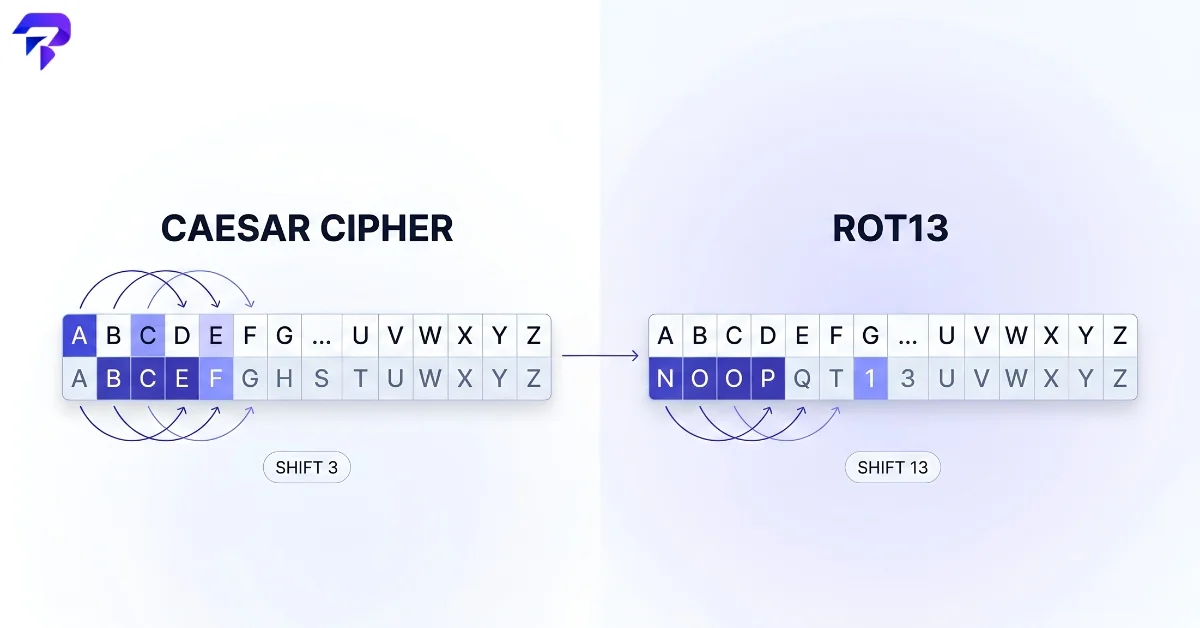
Quick answer: ROT13 is a Caesar cipher — the same technique, just locked to a shift of exactly 13 letters instead of a shift you choose yourself. Neither one is real security: both can be broken instantly by hand or by any basic tool, because there are only 26 possible shifts to try. They’re useful for obscuring text from casual view (spoilers, puzzle answers, joke punchlines), not for protecting anything you actually need kept secret.
What a Caesar cipher actually does
A Caesar cipher shifts every letter in a message forward through the alphabet by a fixed number of positions. Shift by 3, and A becomes D, B becomes E, and so on, wrapping back to the start once you pass Z. The name comes from Julius Caesar, who is traditionally credited with using a shift of 3 to protect military messages — simple enough to encode and decode by hand, which was the whole point for a battlefield commander with no other tools available.
The shift amount is the cipher’s only variable, usually called the “key.” Because the alphabet has just 26 letters, there are only 25 possible shifts worth trying (a shift of 0 or 26 does nothing) — which is exactly why this cipher offers no real protection against anyone motivated enough to try them all.
Where ROT13 fits in
ROT13 is a Caesar cipher with the shift fixed at 13 — literally “rotate by 13.” It has no single inventor; it emerged organically from Usenet culture in the early 1980s as the conventional way to hide spoilers, punchlines, and content some readers might not want to see immediately, requiring only a single keystroke from anyone who wanted to reveal it.
Shift-13 has one property no other shift amount has: since the alphabet has 26 letters, applying ROT13 twice returns you exactly to the original text (13 + 13 = 26, a full trip around the alphabet). That makes ROT13 its own inverse — the same operation both encodes and decodes, so a tool doesn’t even need an “encode” and “decode” mode. Every other Caesar shift needs the opposite shift applied to reverse it.
Caesar cipher vs. ROT13, side by side
| Attribute | Caesar cipher (general) | ROT13 |
|---|---|---|
| Shift amount | Any value 1–25, chosen by the user | Fixed at 13 |
| Self-reversing? | No — needs the opposite shift to decode | Yes — applying it twice restores the original |
| Historical origin | Attributed to Julius Caesar, shift of 3 | Usenet convention, early 1980s |
| Typical modern use | Teaching cryptography basics, simple puzzles | Hiding spoilers, quiz answers, forum content |
| Security level | None — 25 shifts to brute-force | None — the shift isn’t even a secret |
Why neither one is actually encryption
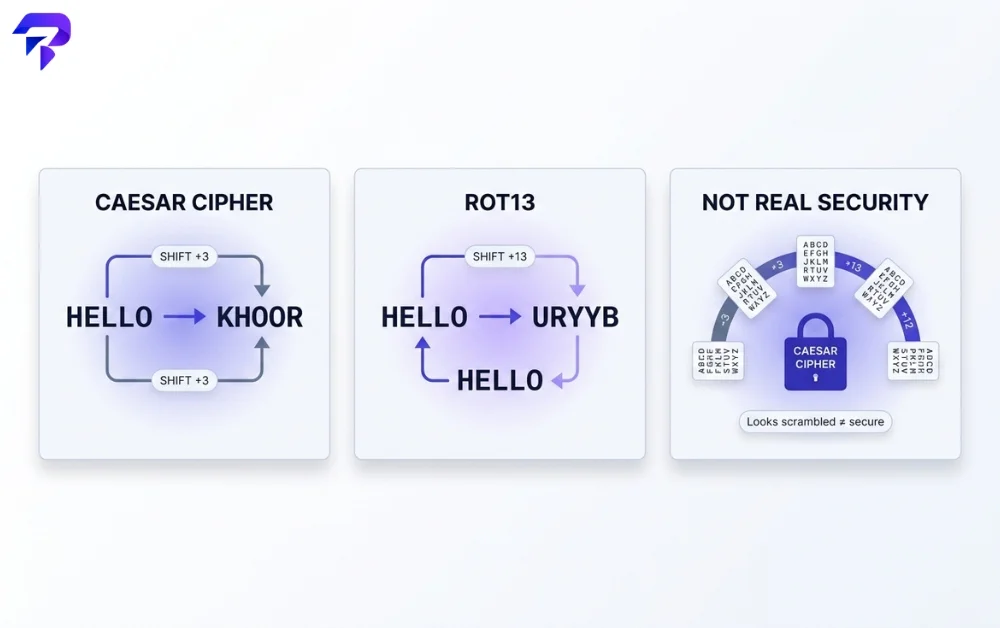
This is the distinction that trips people up: both ciphers visibly scramble text, which looks like security, but “looks scrambled” and “is secure” are unrelated properties. A Caesar cipher can be broken in seconds through frequency analysis — every language has a predictable distribution of letters (E and T are common in English, for instance), so lining up the scrambled letter frequencies against the expected ones reveals the shift almost immediately, even without trying all 25 by hand. ROT13 doesn’t even need that: the shift is fixed and public, so “breaking” it is just running the same operation again.
Real encryption depends on a secret key that isn’t trivially guessable and isn’t vulnerable to statistical shortcuts — see our comparison of MD5 vs. SHA-256 for how modern hashing algorithms are actually designed to resist exactly this kind of attack. It’s also worth keeping the categories straight: encoding (like Base64) just reformats data for safe transport and was never meant to hide anything; a Caesar cipher obscures data with a trivially breakable shift; and modern encryption protects data with a key that’s computationally infeasible to guess. All three transform text, but only one of them is built to withstand someone actually trying to break it.
When a Caesar cipher or ROT13 is actually the right tool
Despite offering zero real security, both ciphers still have legitimate uses precisely because they’re not meant to stop a determined reader — just a casual glance:
- Hiding spoilers or answers — forum posts, puzzle hunts, and trivia questions use ROT13 so people can choose when to reveal the answer
- Teaching cryptography fundamentals — Caesar ciphers are the standard first example for explaining keys, shifts, and frequency analysis before moving on to real cryptographic algorithms
- Lightweight obfuscation in code or configs — occasionally used to keep a string from being immediately human-readable in a log file, with zero expectation of it stopping anyone determined
- Puzzle and game design — escape rooms and alternate-reality games use classic ciphers because they’re solvable without special tools, which is the point
If what you actually need is to keep something secret from someone motivated to look — a password, a private note, sensitive text you’re sending elsewhere — reach for a tool built for that job instead. ToolPremier’s Text Encryptor / Decryptor handles real encryption for text, and if the goal is storing a password rather than hiding a message, our guide on generating a strong password covers the more relevant tool for that job.
Try both ciphers yourself
ToolPremier’s Caesar Cipher tool lets you pick any shift from 1–25 and see the result instantly, which is the fastest way to see frequency patterns emerge for yourself on a longer piece of text. The ROT13 Encoder / Decoder runs the fixed shift-13 version — paste in text, and running it through a second time brings back the original.
FAQs
Do numbers, spaces, and punctuation get shifted too, or just letters?
Convention (and most tools, including ToolPremier’s) only shift alphabetic letters, leaving numbers, spaces, and punctuation exactly where they are. Case is typically preserved as well — an uppercase letter shifts to another uppercase letter, lowercase to lowercase — so “Hello, World! 123” stays readable as normal punctuation and digits with only the letters scrambled.
How is a Caesar cipher different from a general substitution cipher?
A Caesar cipher is one specific, narrow type of substitution cipher: every letter shifts by the same fixed amount, which is why there are only 25 possible keys to try. A general substitution cipher maps each letter to any other letter with no fixed pattern — there are roughly 26! (a number with 27 digits) possible mappings, which makes brute-forcing every possibility completely impractical. General substitution ciphers are still breakable through frequency analysis, just like Caesar ciphers, but they take meaningfully more effort than checking 25 shifts by hand.
Can a Caesar cipher be combined with other techniques to make it stronger?
Historically, yes — the Vigenère cipher is essentially multiple Caesar shifts applied in a repeating pattern based on a keyword, so different letters in the message get shifted by different amounts instead of one fixed shift throughout. That defeats simple frequency analysis on the whole message, though the pattern can still be broken with more advanced techniques once the keyword length is worked out. It’s a genuine historical step up from a plain Caesar cipher, but it’s still nowhere near modern encryption standards.
Is ROT13 actually used in any real software, or is it purely for forum spoilers?
It shows up in a handful of real technical contexts beyond spoilers — the Unix tr command has long been a standard way to apply ROT13 from the command line, and some older email clients and Usenet newsreaders included a built-in ROT13 toggle for reading tagged content. These are all still the same “hide from a casual glance, not from anyone trying” use case described above — no legitimate modern software relies on ROT13 for actual data protection.
The bottom line
ROT13 isn’t a different cipher from the Caesar cipher — it’s the same technique with the shift locked at 13, which happens to make it its own reverse operation. Both are genuinely useful for low-stakes obscuring (spoilers, puzzles, teaching examples) and genuinely useless as security, since there are only 25 shifts to check and the pattern gives itself away almost immediately. For anything you actually need to protect, use real encryption or a proper password hash instead.