The definition, precisely
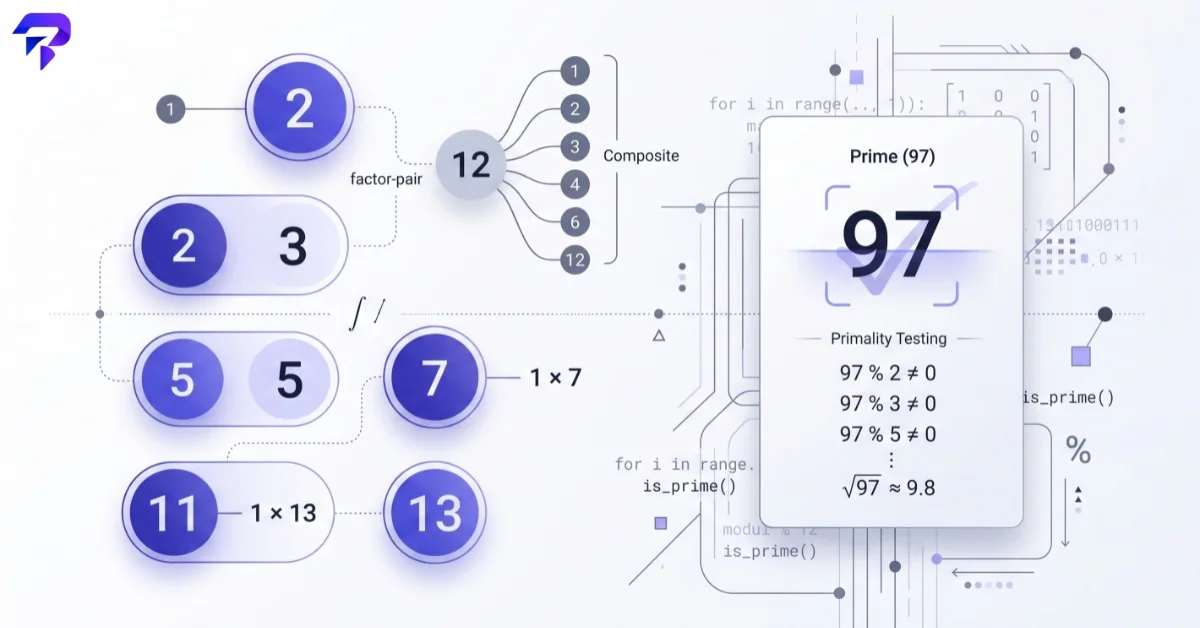
A number is prime if it’s greater than 1 and divisible by nothing except 1 and itself. This precision matters: 4 isn’t prime because it’s also divisible by 2. 9 isn’t prime because it’s also divisible by 3. But 7 is prime — try dividing it by 2, 3, 4, 5, or 6, and none of them work evenly.
Two edge cases trip people up every time:
Why isn’t 1 prime? Because the definition requires exactly two distinct divisors, and 1 only has one (itself). Mathematicians deliberately excluded 1 — if it counted as prime, foundational results like the fundamental theorem of arithmetic (that every number has one unique prime factorization) would break, since you could pad any factorization with extra 1s.
Why is 2 the only even prime? Every even number besides 2 is divisible by 2 in addition to 1 and itself — that’s a third divisor, which disqualifies it. 2 is the sole exception because dividing it by 2 just gives you itself back.
How to check if a number is prime by hand
The straightforward method is trial division: check whether any number from 2 up to the square root of your target number divides it evenly. If none do, it’s prime.
The square root cutoff isn’t arbitrary — it’s a genuine shortcut. If a number n has a divisor larger than its square root, it must also have a matching divisor smaller than the square root (since divisors pair up to multiply back to n), so you’d have already found it. Checking up to the square root is enough.
Worked example: is 97 prime? Its square root is just under 10, so check divisibility by 2, 3, 5, and 7 (skipping even numbers past 2 and multiples already covered). 97 is odd, not divisible by 3 (9+7=16, not a multiple of 3), doesn’t end in 0 or 5, and 97 ÷ 7 ≈ 13.86, not even. No divisor found up to the square root — 97 is prime.
That’s fast for small numbers but gets slow quickly by hand as numbers grow. ToolPremier’s prime number checker runs this instantly for numbers of any practical size.
Why primality testing matters beyond math class
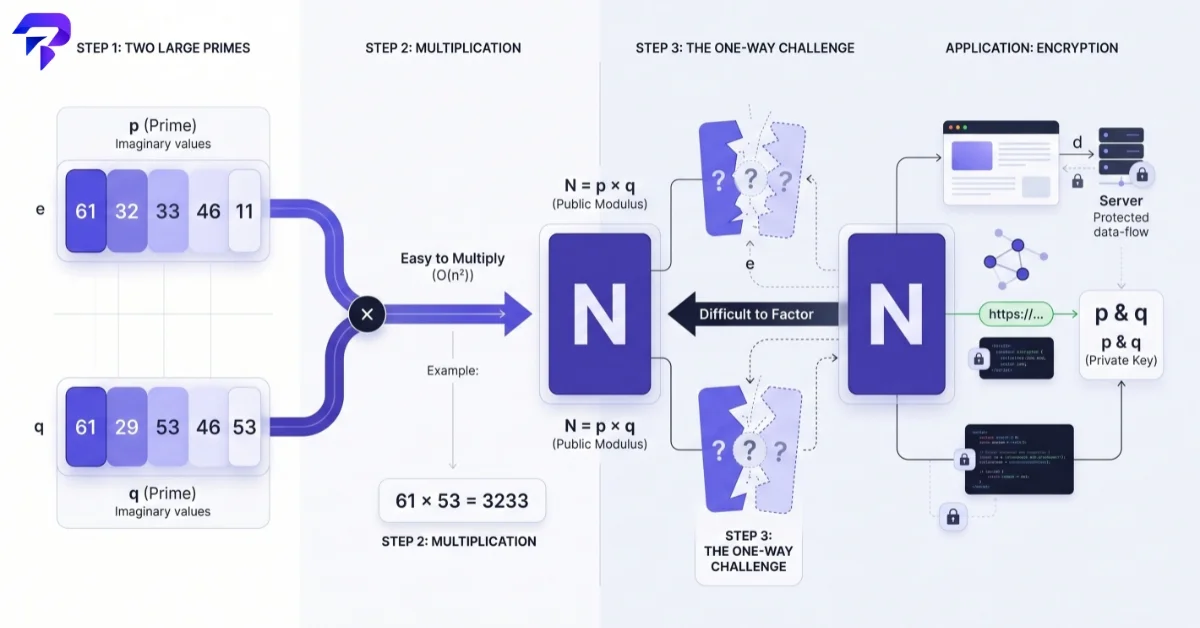
The most consequential real-world use is cryptography. Public-key systems like RSA rely on a genuinely asymmetric problem: it’s computationally easy to multiply two large prime numbers together, but extremely hard to reverse the process and factor the resulting product back into its two original primes, once those numbers get large enough (hundreds of digits). That one-way difficulty is what secures a large share of everyday encrypted traffic, including HTTPS connections.
Beyond cryptography, primes show up in hashing algorithms, error-detection schemes, and various areas of computer science where their “only divisible by themselves” property makes them useful for avoiding predictable patterns.
Generating primes vs. checking them
Checking whether a specific number is prime and generating a list of prime numbers are related but different problems. Generation typically uses an algorithm like the Sieve of Eratosthenes — starting with a range of numbers and systematically eliminating multiples of each prime found, leaving only primes behind — which is far more efficient than checking each number individually one at a time. ToolPremier’s prime number generator handles this directly if you need a list rather than a single check.
For context on how large these numbers can get: the largest known primes today have tens of millions of digits, discovered through distributed computing projects like the Great Internet Mersenne Prime Search (GIMPS), which has run continuously for decades specifically hunting for new record primes.
Related numeric concepts worth knowing
Primes are just one way of looking at how numbers are built. If you’re curious how numbers are represented differently depending on context, our guide to binary, decimal, and hex covers the base systems computers and programmers actually use — and ToolPremier’s number system converter converts between them directly. If prime numbers have you thinking about number sequences more broadly, the Fibonacci sequence generator is a related rabbit hole — a completely different rule for generating numbers (each one the sum of the two before it) that also turns up constantly in nature and computer science. And if you’ve ever wondered about a much older numbering system, see our breakdown of how Roman numerals work.
FAQ
Is 1 a prime number?
No. It has only one divisor (itself), and the definition of a prime requires exactly two.
Is 0 a prime number?
No. Zero is divisible by every number, which is the opposite of the “only two divisors” requirement — it doesn’t fit the definition at all.
What’s the largest known prime number?
It changes as distributed computing projects like GIMPS find new ones, and current record primes run to tens of millions of digits — far too large to write out, let alone use for anything but research into number theory itself.
The bottom line
A prime number’s definition is simple — exactly two divisors — but that simple rule underpins everything from basic number theory to the encryption securing modern internet traffic. Trial division up to the square root is all you need to check one by hand; for anything larger, a dedicated checker or generator does the same math instantly.