How to rewrite a paragraph without changing its meaning
The fastest way to do this by hand is to work at three levels at once: swap individual words for close synonyms, reorder clauses within each sentence, and vary sentence length so the paragraph does not just mirror the original’s rhythm. Change only one of those and the rewrite still reads like a copy with different words; change all three and the meaning survives while the wording genuinely does not.
Before: “Remote work has become more common since 2020. Many companies now let employees work from home at least part of the week. This has changed how offices are designed, since fewer desks are needed on any given day.”
After: “Since 2020, working remotely has shifted from the exception to the norm — a large share of companies now allow staff to split their week between home and the office. That shift has reshaped office design itself: with fewer people in the building on any single day, fewer permanent desks are needed.”
Notice what changed and what did not. The facts are identical — the timeframe, the hybrid arrangement, the knock-on effect on office design. What changed is sentence structure (two short sentences became one longer one), word choice (“has become more common” became “has shifted from the exception to the norm”), and clause order (the cause now leads instead of trailing). That is the difference between rewriting and simply re-typing with synonyms.
Doing this manually for one paragraph is manageable. For a full page or a batch of paragraphs, running the same text through the rewriter tool applies that kind of structural and lexical variation automatically — paste in the paragraph or article and it restructures sentence order and wording while keeping the meaning intact. Always re-read the output afterward against the checklist above: meaning intact, facts intact, nothing dropped.
What a paraphrasing tool actually does
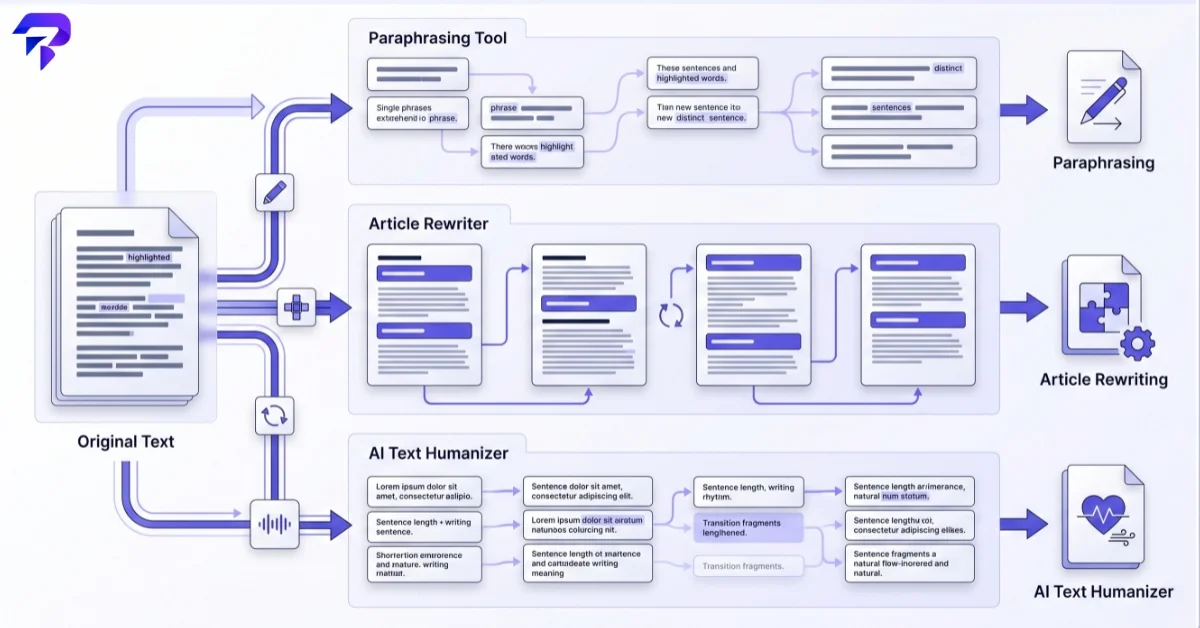
A paraphrasing tool works at the sentence and phrase level. It swaps in synonyms, reorders clauses, and adjusts sentence structure while trying to preserve the original meaning. The practical use cases are narrow and specific: rewording a sentence that’s awkward, avoiding exact repetition of a phrase you’ve already used elsewhere on the page, or getting a fresh angle on a line that isn’t landing.
What it isn’t good at is anything requiring judgment about structure, argument, or flow across a whole piece — that’s a different tool’s job.
What an article rewriter does differently
An article rewriter operates at the document level rather than the sentence level. Instead of reworking individual lines, it’s built to take a full article or long section and produce a restructured version — useful when you’re repurposing your own content (turning a blog post into a different format, adapting a piece for a different audience, or refreshing older content) rather than fine-tuning one line.
The tradeoff is that rewriting at scale needs more review afterward. A sentence-level paraphrase is easy to spot-check; a fully rewritten article needs a proper read-through to confirm facts, names, and structure survived the process intact.
What “humanizing” AI text actually means
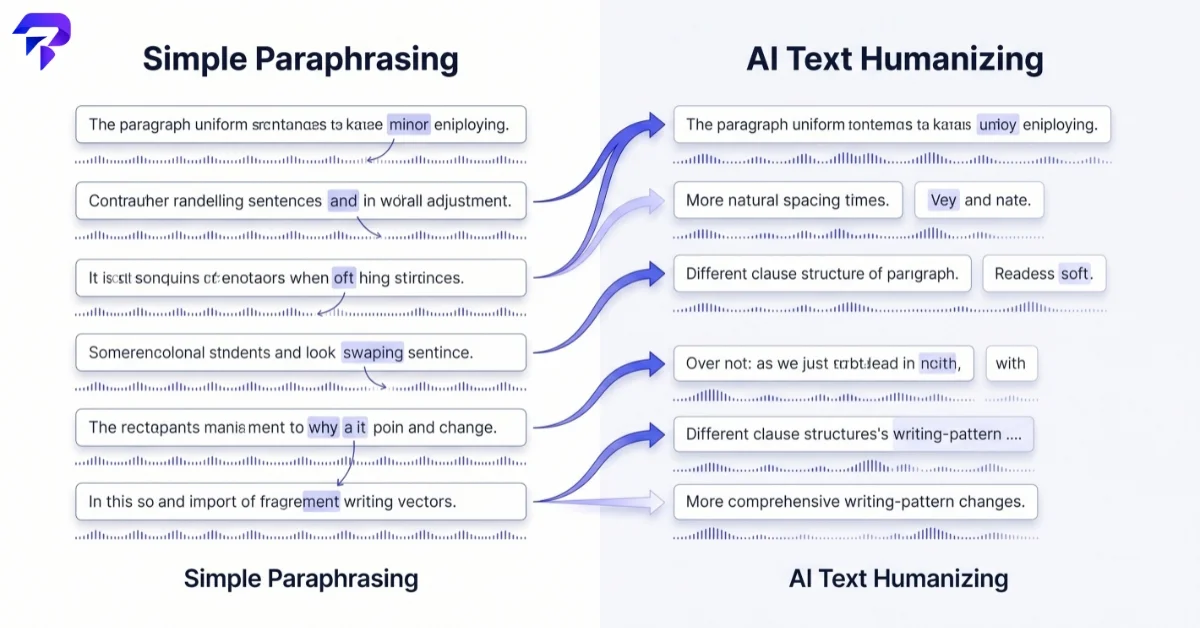
This is the part that trips people up, because it sounds like a fancier paraphraser — it isn’t. AI-detection tools generally look at statistical properties of text: perplexity (how predictable each next word is, given the words before it) and burstiness (how much sentence length and structure vary across a passage). AI-generated text tends to score lower on both — smoother, more uniform, more statistically “expected” than typical human writing, which tends to be more irregular.
A humanize AI text tool specifically targets those patterns — varying sentence length and rhythm, introducing more natural irregularity — rather than just changing words. That’s a meaningfully different goal from paraphrasing, and it’s why running AI-generated text through a plain paraphraser often doesn’t move the needle much on detection tools, while a humanizer is built specifically to.
Worth being direct about the ethical line here: humanizing tools are legitimate for smoothing genuinely human-edited drafts, avoiding false-positive AI flags on your own writing, or adapting AI-assisted first drafts into your own voice before publishing. They’re not a way to misrepresent AI-generated academic or professional work as entirely your own where that violates a stated policy — the tool changes the pattern, not the underlying provenance of the ideas.
Which one should you actually use?
It comes down to what problem you’re solving:
Reword one awkward sentence → paraphrasing tool. Repurpose or refresh a full piece of content → article rewriter. Reduce a false-positive AI-detection flag or smooth an AI-assisted draft into something that reads naturally → humanizer. Check where your content currently stands against a detector before or after any of the above → an AI content detector.
Before you publish
Whichever tool you use, run the result through a normal editing pass afterward — automated rewriting can introduce awkward phrasing or subtly change a fact. A grammar checker catches the mechanical issues, and if you’ve rewritten something down from a longer source, a text summarizer can help you sanity-check that the shortened version still says what you meant.
FAQ
Does paraphrased content still count as plagiarism?
It can, if the structure and ideas are copied too closely even with different words — plagiarism checkers and academic integrity standards generally look at substantive similarity, not just exact wording. See our guide on how plagiarism checkers actually work for how that gets evaluated.
Will a humanizer beat every AI detector?
No tool can guarantee that, since detectors vary in method and keep changing. Treat humanizing as a way to make text read more naturally, not as a guaranteed bypass for any specific detection tool.
Does paraphrasing help or hurt SEO?
Neither, by itself. Search engines evaluate content on usefulness and originality of substance, not on how many synonyms were swapped in. Paraphrasing a thin page doesn’t make it more valuable — the underlying content still needs to answer the query well.
The bottom line
These three tools solve three different problems: a paraphraser reworks wording, a rewriter restructures at scale, and a humanizer targets the statistical fingerprint AI detectors look for. Picking the wrong one for the job is the most common reason people are disappointed with the result — match the tool to what’s actually broken about the text.