
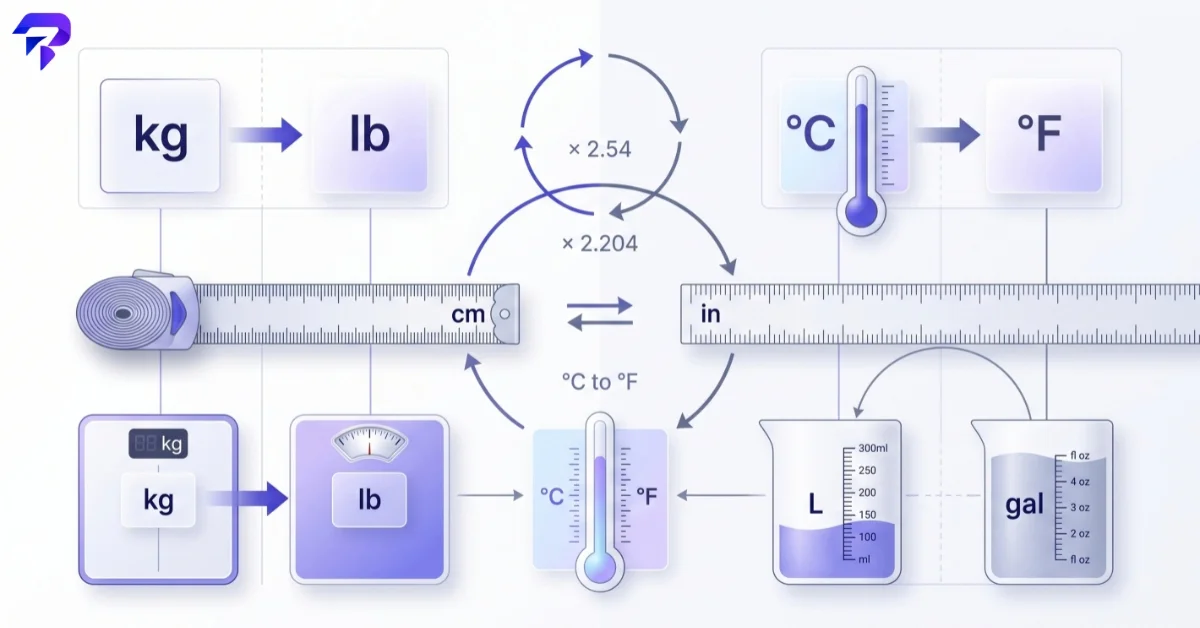
Quick answer: The core conversions people actually search for are: 1 inch = 2.54 cm, 1 foot = 0.3048 m, 1 mile = 1.609344 km, 1 pound = 0.453592 kg, and Celsius to Fahrenheit is °F = (°C × 9/5) + 32. All of these are exact, internationally defined figures — not rounded approximations — because the inch, pound, and their relatives were formally redefined against the metric system in 1959. This guide covers length, weight, temperature, volume, area, and speed, with the exact formulas and the common rough shortcuts people use for quick mental math. If you just need a number right now, ToolPremier’s length converter and weight converter do all of this instantly.
This is a practical reference for converting between the two systems correctly — for the story of why the US still measures in feet and pounds while most of the world uses meters and kilograms, see our explainer on why the US still uses imperial units.
Why These Numbers Are Exact, Not Approximate
Most people assume conversions like “1 inch = 2.54 cm” are rounded for convenience. They’re not. Since the 1959 International Yard and Pound Agreement, the inch has been defined as exactly 2.54 centimeters by international treaty among the US, UK, Canada, Australia, and other English-speaking nations. Every other imperial length unit (foot, yard, mile) derives from that fixed inch, which is why foot-to-meter and mile-to-kilometer conversions carry long, exact decimals rather than tidy round numbers.
The pound went through a similar process: since 1959, the international avoirdupois pound has been defined as exactly 0.45359237 kilograms. So when a conversion table gives you a long decimal instead of a clean fraction, that’s not sloppy rounding — it’s the actual defined relationship between the two systems.
Practically, this matters most when precision counts — engineering drawings, medication dosing, scientific work, manufacturing tolerances. For everyday use (recipes, travel, fitness), the rounded shortcuts later in this guide are close enough.
Length: Inches, Feet, Miles ↔ Centimeters, Meters, Kilometers
| Imperial | Exact metric equivalent | Quick mental shortcut |
|---|---|---|
| 1 inch | 2.54 cm | ~2.5 cm |
| 1 foot | 0.3048 m | ~30 cm |
| 1 yard | 0.9144 m | ~0.9 m |
| 1 mile | 1.609344 km | miles × 1.6 |
| 1 cm | 0.393701 in | ~0.4 in |
| 1 meter | 3.28084 ft | ~3.3 ft |
| 1 km | 0.621371 mi | km × 0.62 |
The mile-to-kilometer shortcut is the one worth memorizing if you travel: multiply miles by 1.6 to get a close kilometer estimate, or multiply kilometers by 0.6 to get a close mile estimate. It’s accurate to within a couple percent, which is fine for reading a road sign or a race distance. For anything that needs to be exact — shipping dimensions, construction measurements, recipe conversions where a small error compounds — run it through the length converter instead of doing the mental shortcut.
Weight: Pounds, Ounces, Stone ↔ Kilograms, Grams
| Imperial | Exact metric equivalent | Quick mental shortcut |
|---|---|---|
| 1 ounce | 28.3495 g | ~28 g |
| 1 pound | 0.453592 kg | ~0.45 kg |
| 1 stone (14 lb) | 6.35029 kg | ~6.35 kg |
| 1 kg | 2.20462 lb | kg × 2.2 |
| 1 gram | 0.035274 oz | ~0.035 oz |
“Stone” trips up a lot of people converting body weight, since it’s still the everyday unit in the UK and Ireland for a person’s weight, but almost nowhere else. One stone is 14 pounds, so a UK weight given as “11 stone 3” is 11 × 14 + 3 = 157 pounds, or about 71.2 kg. The weight converter handles stone directly so you don’t have to do that multiplication by hand.
Temperature: Fahrenheit ↔ Celsius
Temperature is the one conversion in this guide that isn’t a simple multiplication — it’s a linear formula with an offset, because the two scales don’t share a zero point:
°F to °C: °C = (°F − 32) × 5/9
°C to °F: °F = (°C × 9/5) + 32
Worked example: 98.6°F (normal human body temperature) converts to (98.6 − 32) × 5/9 = 37°C. Going the other way, a 20°C room converts to (20 × 9/5) + 32 = 68°F.
A rough mental shortcut for Celsius to Fahrenheit that’s close enough for weather checking: double the Celsius number and add 30. 20°C × 2 = 40, + 30 = 70°F — close to the real answer of 68°F. It drifts further off as temperatures get more extreme, so for cooking, medical, or scientific use, use the exact formula or ToolPremier’s temperature converter rather than the shortcut.
Two reference points worth memorizing: water freezes at 0°C / 32°F and boils at 100°C / 212°F at sea level.
Volume: Gallons, Quarts, Cups ↔ Liters, Milliliters
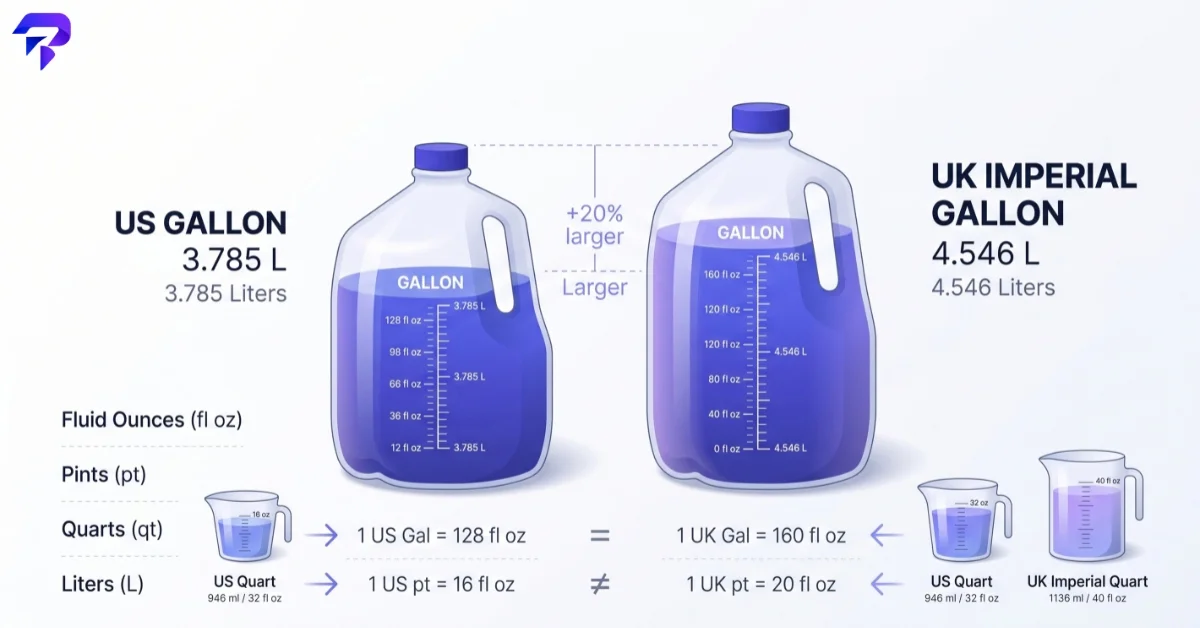
Volume is where a lot of conversion mistakes happen, because “gallon” and “cup” don’t mean the same thing everywhere. A US gallon (3.785411784 liters) is noticeably smaller than a UK/imperial gallon (4.54609 liters) — about 17% smaller. The same split applies to fluid ounces, pints, and quarts. If a recipe or spec doesn’t say which system it’s using, check the source’s country before converting, or the number will be off by a meaningful margin.
| Unit | Metric equivalent |
|---|---|
| 1 US fluid ounce | 29.5735 mL |
| 1 US cup | 236.588 mL |
| 1 US quart | 0.946353 L |
| 1 US gallon | 3.785412 L |
| 1 UK (imperial) gallon | 4.54609 L |
| 1 liter | 0.264172 US gal / 0.219969 UK gal |
For cooking specifically, US recipe cups are a volume measure, while many countries measure baking ingredients by weight (grams) instead — which is actually more accurate, since a “cup of flour” varies depending on how packed it is. If you’re converting a US recipe, the volume converter handles the US-vs-UK gallon distinction automatically so you’re not guessing which one a source meant.
Area, Speed, and a Few Others Worth Knowing
A handful of other conversions come up often enough to include here, even though they get less search traffic than length, weight, and temperature:
-
- Area: 1 acre = 4,046.86 m² (about 0.405 hectares). 1 square mile = 2.59 km². Real estate listings, farmland, and land surveys often switch between acres and hectares depending on the country — the area converter covers both plus square feet/meters.
- Speed: 1 mph = 1.609344 km/h. Road signs, speedometers, and wind forecasts are the most common places this comes up when crossing between US/UK and the rest of the world — the speed converter handles mph, km/h, and knots.
- Pressure: 1 psi = 6,894.76 pascals (6.89476 kPa). Tire pressure is the most common real-world case — US tire door stickers are usually in psi, while many other countries use bar or kPa. The pressure converter covers psi, bar, kPa, and atm.
- Fuel efficiency: this one doesn’t even share a direction — mpg (miles per gallon) is distance per volume, while L/100km (liters per 100 kilometers) is volume per distance, so a straight multiplication won’t work; it requires an inverse calculation. The fuel efficiency converter handles the inversion so you don’t have to do it by hand, and also accounts for the US-vs-UK gallon difference.
- Energy: 1 BTU = 1,055.06 joules. Appliance ratings (especially air conditioners and heaters) sometimes use BTU in the US and watts or kilowatts elsewhere — the energy converter covers both.
Common Conversion Mistakes
A few errors show up constantly, regardless of which unit is involved:
-
-
- Confusing US and UK gallons/pints/ounces. The volume units share a name but not a size across the Atlantic. Always confirm which system a source is using before converting a recipe, fuel economy figure, or fluid measurement.
- Using the “double and add 30” temperature shortcut for anything precise. It’s fine for deciding what to wear; it’s not fine for a fever, a recipe, or a lab reading.
- Rounding too early in multi-step conversions. If you’re converting feet to meters and then multiplying by something else, rounding the intermediate meter figure to one decimal place before the next calculation can introduce a meaningful error by the end. Keep full precision until the final answer.
- Mixing up mpg and L/100km directionality. A higher mpg is more efficient; a higher L/100km is less efficient — they move in opposite directions, which trips people up when comparing a US car’s mpg rating to a European car’s L/100km rating.
-
FAQs
Is “imperial” the same thing as “US customary units”?
Not quite, though people use the terms interchangeably. Imperial units are the historical British system; US customary units evolved from the same root but split off before the UK standardized imperial in 1824, so a handful of units differ in size between them — the volume section above is the clearest example, where the US gallon (3.785 L) and the UK imperial gallon (4.546 L) are genuinely different sizes despite the shared name. Length units like the foot and mile are identical in both systems; volume units are where the split actually shows up.
Why is a nautical mile different from a regular mile?
They’re built on different logic. A statute mile (1.609344 km, the one in the table above) is a fixed historical land-measurement unit. A nautical mile (1.852 km) is instead defined as one minute of latitude on the Earth’s surface, which makes it directly useful for navigation and chart plotting at sea and in the air. That’s why aviation and maritime contexts use nautical miles and knots, while road distances and everyday conversions use the statute mile.
Which countries still primarily use imperial or US customary units?
The United States is the largest example, alongside Liberia and Myanmar, which are commonly cited as the only other countries not officially on the metric system. In practice it’s less clean-cut than that: the UK is officially metric but still uses miles and mph on roads, pints for beer and milk, and stone for body weight — a hybrid that trips up a lot of conversions between American and British sources even though both are “English-speaking imperial-ish” countries.
Why does the “double and add 30” temperature shortcut get worse at extreme temperatures?
The shortcut approximates the real conversion slope of 9/5 (1.8) with a rounder 2, which is close near everyday temperatures but compounds as the numbers get larger. At 20°C the shortcut is only 2°F off; at 40°C it’s already off by about 6°F, and the gap keeps widening in both directions. It’s a fine mental-math trick for checking the weather, but the exact formula (or the converter) is the right call for anything further from room temperature.
The Bottom Line
Metric-to-imperial conversions aren’t rounded estimates — since 1959 they’ve been fixed, exact figures defined by international agreement, which is why the decimals run long instead of landing on tidy numbers. The rough shortcuts in this guide (miles × 1.6, kg × 2.2, double-and-add-30 for temperature) are good enough for everyday situations like travel and casual conversation, but anywhere precision actually matters — cooking, medicine, construction, engineering — use the exact formulas or run the number through ToolPremier’s length, weight, and temperature converters instead of doing the math by hand.