Simple Interest vs. Compound Interest: The Actual Difference
Simple interest is calculated only on the original principal, every period, forever. Compound interest is calculated on the principal plus whatever interest has already accumulated. That’s the entire difference — but it compounds (no pun intended) into a large gap over time.
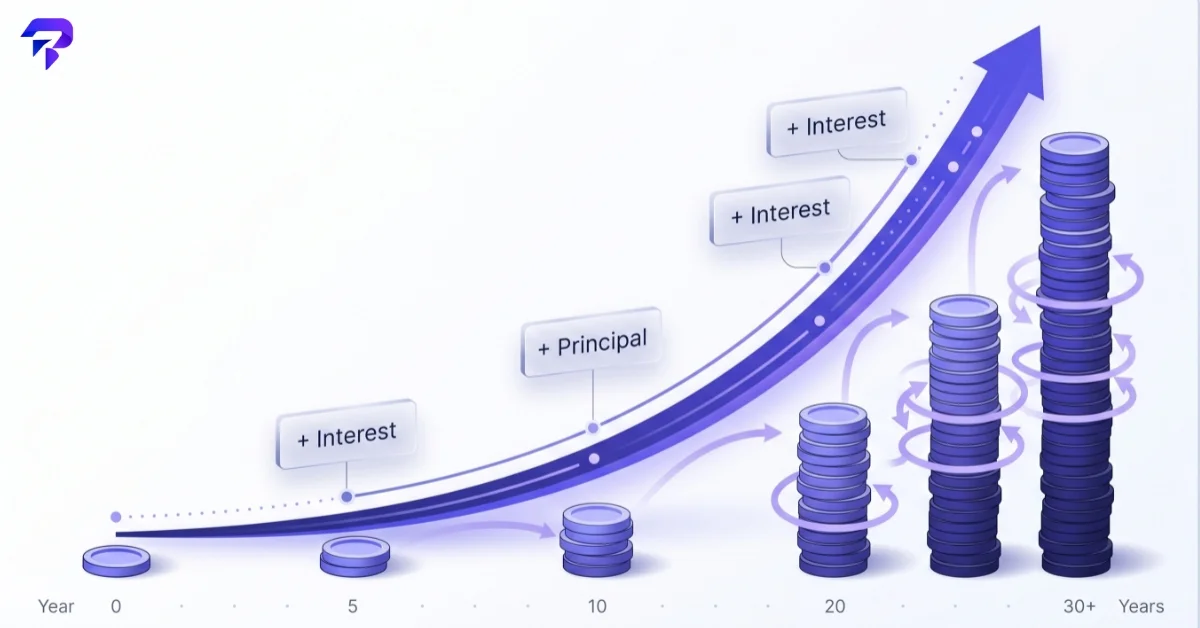
Take $10,000 at 6% annual interest over 20 years. With simple interest, you earn a flat $600 every single year, ending with $22,000 total. With compound interest (compounded annually), year one also earns $600 — but year two earns 6% of $10,600, not $10,000, so it’s $636. By year 20, the balance has grown to roughly $32,071, more than $10,000 ahead of the simple-interest version, without adding a single extra dollar of your own money. The rate and the time period were identical — the only difference is whether interest earns interest.
| Year | Simple interest balance | Compound interest balance (annual) |
|---|---|---|
| 1 | $10,600 | $10,600 |
| 5 | $13,000 | $13,382 |
| 10 | $16,000 | $17,908 |
| 20 | $22,000 | $32,071 |
Notice how close the two stay in the early years and how far apart they drift later — that’s the defining shape of compound growth. It looks unremarkable for a while and then visibly accelerates. This is also exactly why starting early matters more than almost any other single factor in long-term investing: the extra years at the end of the curve are where most of the growth happens.
Breaking Down the Formula
A = P(1 + r/n)nt
-
- A — the final amount, principal plus all accumulated interest
- P — the principal, your starting balance
- r — the annual interest rate, as a decimal (5% = 0.05)
- n — how many times per year interest compounds (1 = annually, 12 = monthly, 365 = daily)
- t — the number of years the money grows
Worked example: $5,000 at 5% annual interest, compounded monthly, for 10 years. n = 12, r = 0.05, t = 10. A = 5,000 × (1 + 0.05/12)12×10 = 5,000 × (1.004167)120 ≈ $8,235. Compare that to the same rate compounded only once a year: A = 5,000 × (1.05)10 ≈ $8,144. More frequent compounding produces a slightly higher result at the same stated rate, because interest starts earning interest sooner within each year.
Compounding Frequency: Why It Matters (a Little)
This is why two accounts advertising the same interest rate can produce different actual returns — the one that compounds more often (daily or monthly vs. annually) edges out the other, even though the stated rate is identical. This is also the reason lenders and account providers distinguish between the nominal rate and the APY (annual percentage yield) — APY already factors in compounding frequency, so it’s the number that reflects what you’ll actually earn (or, on a loan, actually owe) over a year. When comparing two savings accounts or two loans, compare APY to APY, not nominal rate to nominal rate — they can rank differently.
The Rule of 72: A Fast Mental Shortcut
The Rule of 72 estimates how many years it takes an amount to double at a given annual compound rate, without running the full formula: years to double ≈ 72 ÷ rate (as a whole number, not a decimal).
| Annual rate | 72 ÷ rate | Approx. years to double |
|---|---|---|
| 3% | 72 ÷ 3 | 24 years |
| 6% | 72 ÷ 6 | 12 years |
| 9% | 72 ÷ 9 | 8 years |
| 12% | 72 ÷ 12 | 6 years |
It’s a back-of-the-envelope estimate, not an exact calculation — it gets slightly less accurate at very high or very low rates — but it’s genuinely useful for quick comparisons, like sanity-checking whether an investment’s stated return actually makes sense over your time horizon. For an exact answer instead of an approximation, use the compound interest calculator directly.
Compound Interest Works Against You Too
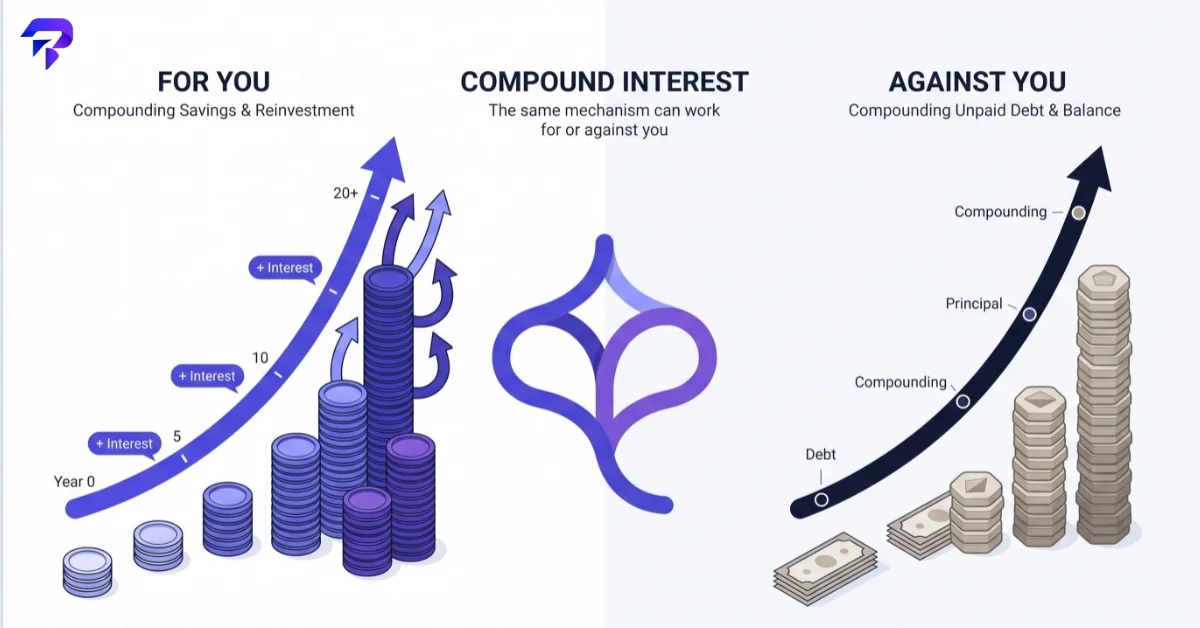
Everything above describes compound interest growing your savings or investments. The exact same mechanism applies to debt — credit card balances, most loans, and mortgages all compound, which is why carrying a balance is so much more expensive than the sticker interest rate suggests over time. A credit card charging 22% APR compounded monthly on an unpaid balance is applying the same accelerating-growth math described above, just in the direction of what you owe instead of what you own.
This is also why an amortizing loan’s interest costs so much more in the early years — most of each early payment goes toward interest on the full remaining balance, and only a small portion reduces the principal. For a specific worked breakdown of that, see how to calculate loan EMI. If you’re comparing what a lump sum grows into against what a loan actually costs, the simple interest calculator is worth checking too — some short-term loans and promotional financing genuinely use simple interest rather than compound, and confirming which one applies before signing anything is worth the extra minute.
Where This Shows Up in Real Financial Decisions
-
-
- Retirement savings. Small, consistent contributions started early tend to outperform larger contributions started late, purely because of extra compounding years — the retirement calculator shows this directly by letting you compare different starting ages at the same contribution rate.
- Recurring investment plans (SIPs). Systematic investment plans add a fixed amount on a schedule, and each contribution starts compounding from the moment it’s invested — the SIP calculator models the combined effect of regular contributions plus compounding growth, which isn’t the same as a single lump sum growing on its own.
- Mortgages. Interest compounds on the outstanding balance, which is why extra principal payments early in a mortgage save more in total interest than the same extra payment made later — the mortgage calculator can model that difference for a specific loan.
- Budgeting around debt payoff vs. saving. If a debt’s interest rate is higher than what you’d realistically earn investing, paying it down first usually wins mathematically, since you’re avoiding a guaranteed compounding cost rather than chasing an uncertain compounding gain. The budget planner helps see both sides of that tradeoff side by side.
-
This article explains general, well-established financial mathematics for informational purposes and isn’t personalized financial advice. Actual returns on investments are never guaranteed and depend on factors a formula can’t predict, including market performance, fees, and taxes. For decisions involving real money, consider talking to a qualified financial advisor.
FAQs
If I withdraw the interest as it’s earned instead of leaving it in the account, do I still get compound growth?
No — that effectively turns it back into simple interest. Compounding only happens because unclaimed interest stays in the balance and earns interest of its own the next period. Withdraw it as soon as it’s credited, and each future period calculates interest on the same original principal again, the same as a simple-interest account would. If the goal is growth, reinvesting (or at least not withdrawing) the interest is what makes the formula’s exponent do any work at all.
Does compounding work the same way for stocks and index funds as it does for a savings account?
Conceptually yes, mechanically not quite. A savings account compounds at a fixed, guaranteed rate. Investment growth compounds too when dividends and gains are reinvested rather than withdrawn — each year’s growth builds on a larger base, the same shape as the formula above — but the rate isn’t fixed or guaranteed; it varies with market performance and can be negative in a given year. The math that describes the growth is the same; the certainty behind the rate is not.
Is there a limit to how much compounding more frequently actually helps?
Yes — there’s a mathematical ceiling called continuous compounding (A = Pert), which represents compounding infinitely often. In practice, the jump from annual to monthly compounding matters more than the jump from monthly to daily, and the jump from daily to continuous is nearly unnoticeable at normal interest rates. Once you’re compounding daily, you’ve already captured almost all of the practical benefit frequency can offer.
Does inflation cancel out the benefit of compound interest?
It can eat into it significantly, which is a different thing from canceling it out. The formulas above calculate nominal growth — the actual dollar amount in the account. Whether that growth increases your real purchasing power depends on whether your rate beats inflation over the same period; a balance earning 3% while inflation runs at 4% is growing in dollar terms but losing ground in what it can actually buy. This is why comparing a stated interest rate to current inflation matters as much as comparing it to other savings options.
The Bottom Line
Compound interest grows faster than simple interest because interest starts earning its own interest — the gap between the two looks small in year one and large by year twenty, using the exact same rate and principal. The Rule of 72 (72 ÷ rate) gives a fast doubling-time estimate for quick comparisons, and the same accelerating math applies to debt as much as it does to savings, which is why paying down high-interest balances is often the better move mathematically. For the exact number on your own numbers, use ToolPremier’s compound interest calculator rather than working through the exponent by hand.